

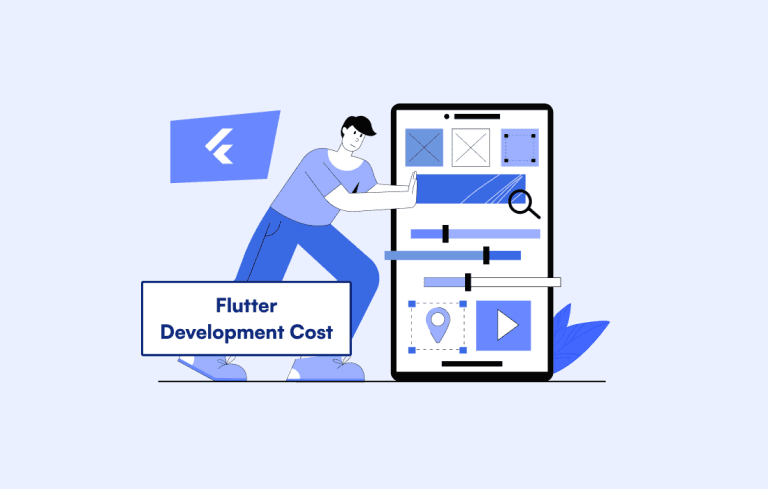
Flutter App Development Cost: Full 2026 Pricing Guide
This guide breaks down Flutter app development costs for 2026 by complexity, team model, and region. It covers everything from MVP budgets to enterprise builds, along with practical tips to keep your project on track financially.

Summarise with AI


You have a product idea. You know Flutter is the framework to build it. But the first question on your mind is probably, “How much is the project going to cost me?”
It is a fair question and also a tricky one. The cost of building a Flutter app in 2026 can range from $10,000 for a bare-bones MVP to $300,000+ for a full enterprise platform. The gap is wide, and it depends on the specifics of your project, the team building it, and its location.
We have been building Flutter apps at SolGuruz since the framework’s early days. As a Google-recognized Flutter agency, we have delivered projects across fintech, healthcare, logistics, and SaaS. So the numbers in this guide come from real project experience, not theory.
Let us walk through every factor that shapes the cost of developing your Flutter app, so you can plan your budget with confidence.
Table of Contents
Flutter App Development Cost: The Quick Answer
Before we get into the pricing details, it helps to understand why businesses choose Flutter app development services over native development in the first place.
Flutter is an open-source UI framework backed by Google. It lets you build apps for iOS, Android, web, and desktop from a single Dart codebase. That single-codebase approach is the main reason it saves money.
Here is what that looks like in practice:
| App Complexity | Estimated Cost | Timeline | Example |
| Simple MVP | $10,000 – $30,000 | 6 – 12 weeks | Habit tracker, calculator, info app |
| Mid-Complexity App | $30,000 – $80,000 | 3 – 6 months | E-commerce, social platform, booking app |
| Complex App | $80,000 – $150,000 | 6 – 9 months | Fintech app, marketplace, real-time messaging |
| Enterprise App | $150,000 – $300,000+ | 9 – 18 months | Multi-role platform, AI features, complex backend |
These numbers cover design, development, testing, and deployment for both iOS and Android using a single Flutter codebase. The biggest advantage? You get two platforms for roughly the price of one. Flutter typically saves 30-40% compared to building separate native apps.
Now, let us break down what actually drives these numbers.
Why Flutter Is Cost-Effective in 2026
Before we get into the pricing details, it helps to understand why businesses pick Flutter over native development in the first place.
Flutter is an open-source UI framework backed by Google. It lets you build apps for iOS, Android, web, and desktop from a single Dart codebase. That single-codebase approach is the main reason it saves money.
Here is what that looks like in practice:
-
One team, multiple platforms.
You hire one set of developers instead of separate iOS and Android teams. That alone cuts your staffing cost in half.
-
Faster development cycles.
Flutter’s hot reload feature lets developers see changes instantly. Teams typically ship 25-35% faster than with native development.
-
Lower maintenance costs.
One codebase means one set of bugs to fix, one set of updates to push. Maintenance costs drop by roughly 40% compared to maintaining two native apps.
-
Proven at scale.
Companies like BMW, Google Pay, Nubank, and Toyota run Flutter in production, serving tens of millions of users. This is not experimental technology anymore.
The mobile app development market is projected to reach $278.58 billion in 2026, growing at a 14.38% CAGR.
Flutter holds roughly 46% of the cross-platform framework market, making it the most widely adopted option for businesses building multi-platform apps.
9 Factors That Drive Flutter App Development Cost
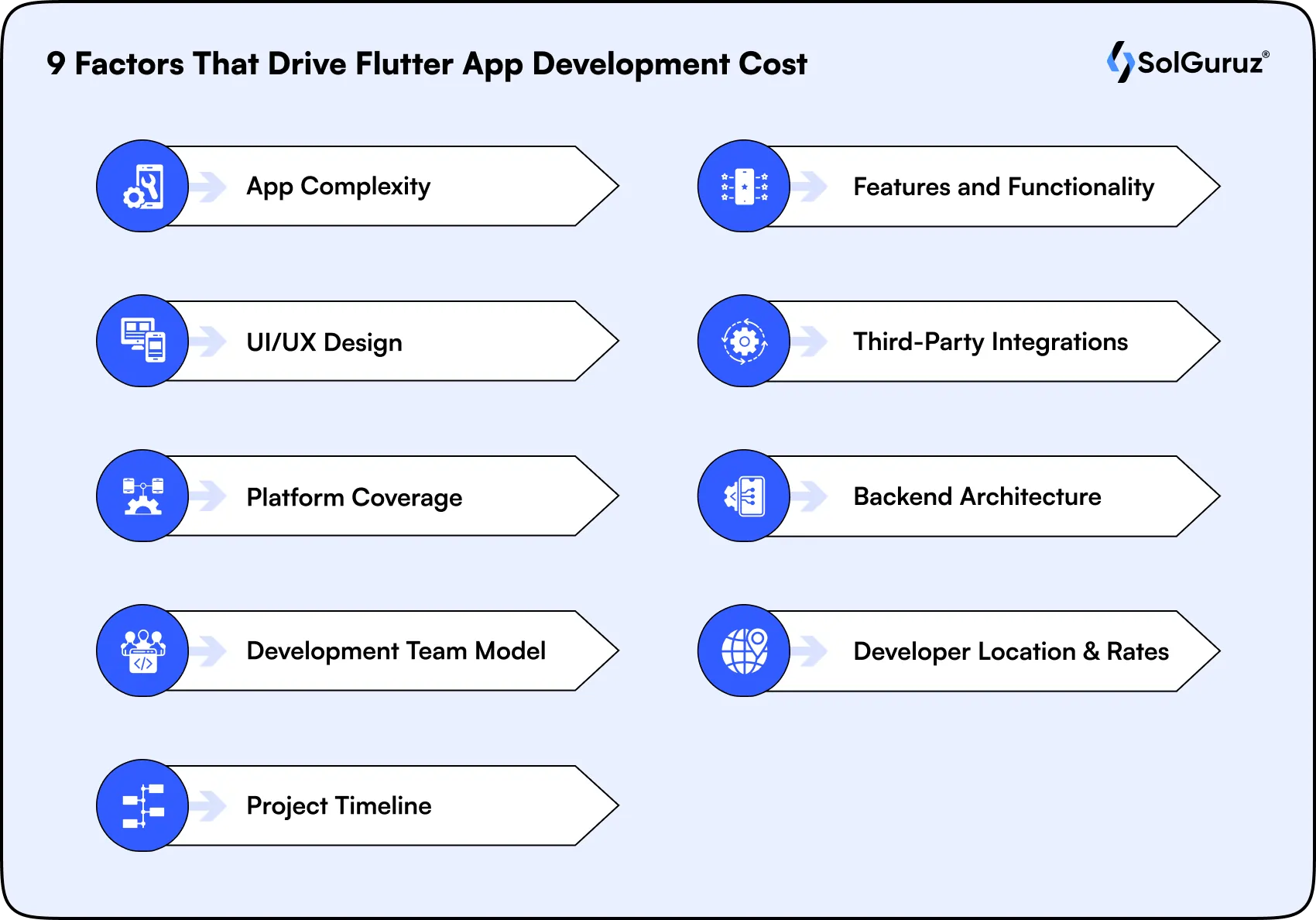
Before diving into the details, let’s explore the key factors that influence Flutter app development cost. From app complexity to team structure, each element has a major impact on your overall budget.
1. App Complexity
This is the single biggest cost driver. A simple app with 5-10 screens and basic functionality is a completely different project from a platform with real-time data sync, multiple user roles, and third-party integrations.
Here is how complexity breaks down:
- Low complexity: Static content, basic forms, simple navigation. Think informational apps, calculators, or single-purpose tools.
- Medium complexity: User authentication, payment processing, API integrations, push notifications. This covers most business apps.
- High complexity: Real-time features, video streaming, machine learning integration, multi-tenant architecture, complex admin panels.
Every layer of complexity adds development hours. And hours are what you are ultimately paying for.
2. Features and Functionality
The features you pick directly shape your budget. Here is a rough cost guide for common Flutter app features:
| Feature | Estimated Cost |
| User login and authentication | $1,500 – $3,000 |
| Payment gateway integration | $2,000 – $5,000 |
| Push notifications | $1,000 – $2,500 |
| GPS and location tracking | $2,000 – $3,500 |
| Chat and messaging | $3,000 – $8,000 |
| Camera and media handling | $1,000 – $2,500 |
| Biometric authentication | $2,000 – $4,000 |
| Admin panel | $5,000 – $15,000 |
| AI/ML integration | $10,000 – $30,000+ |
| AR/VR features | $8,000 – $25,000+ |
Start with the features your users actually need right now. You can always add more in later releases.
3. UI/UX Design
Design is not just about making the app look good. It is about how users navigate, interact, and complete tasks inside your app.
A standard approach using Material Design or Cupertino widgets costs less because Flutter provides pre-built components. However, custom UI UX design with unique animations, micro-interactions, and branded visual systems requires more time and increases the overall cost.
Design typically accounts for 10-20% of your total project cost. For a $50,000 app, that means $5,000 to $10,000 on design alone.
4. Third-Party Integrations
Most apps do not live in isolation. They connect to payment gateways, social media platforms, CRMs, analytics tools, cloud storage, and other APIs.
Each integration adds development time. Simple integrations like Firebase or Google Maps might take a few days. Complex ones like custom ERP connectors or multi-gateway payment systems can take weeks.
The more systems your app talks to, the higher the development cost.
5. Platform Coverage
Flutter supports iOS, Android, web, and desktop in a single codebase. But there is a nuance here.
Building for mobile (iOS + Android) is the default. Adding web or desktop support requires extra testing, platform-specific adjustments, and responsive layout work. Each additional platform adds roughly 15-25% to your total cost.
Most businesses start with iOS and Android, then expand to web or desktop based on user demand.
6. Backend Architecture
Your app needs somewhere to store data, process requests, and handle user authentication. The backend choice has a big impact on cost.
- Firebase (BaaS): Great for MVPs and simpler apps. Low upfront cost, pay-as-you-grow pricing. Suitable for apps with up to 100K users.
- Custom backend: Required for complex business logic, high data volumes, or strict compliance needs. Adds $10,000 – $50,000+ depending on complexity.
If you are building an MVP to test your idea, Firebase is the smart move. For enterprise-grade apps, plan for a custom backend from the start.
7. Development Team Model
How you staff your project makes a real difference in cost, especially when you plan to hire Flutter developers for your app.
| Team Model | Cost Range | Best For | Trade-Off |
| In-house team | $80,000 – $250,000/year | Long-term products, full control | High overhead, recruitment time |
| Outsourced agency | $25,000 – $200,000/project | Most businesses, flexible scaling | Requires good communication setup |
| Freelancers | $10,000 – $60,000/project | Small, simple projects | Quality varies, limited accountability |
For most startups and mid-size businesses, outsourcing to an experienced Flutter agency gives you the best balance of cost, quality, and speed.
8. Developer Location and Hourly Rates
Geography plays a big role in what you pay. Here are typical Flutter developer hourly rates by region in 2026:
| Region | Hourly Rate | Project Cost (Mid-Complexity) |
| North America | $100 – $200/hr | $80,000 – $200,000+ |
| Western Europe | $80 – $150/hr | $60,000 – $150,000 |
| Eastern Europe | $40 – $80/hr | $35,000 – $80,000 |
| India | $18 – $50/hr | $15,000 – $60,000 |
| Latin America | $30 – $70/hr | $25,000 – $70,000 |
| Southeast Asia | $20 – $45/hr | $15,000 – $50,000 |
India offers some of the most competitive rates without compromising on quality, which is why it remains a top outsourcing destination for Flutter projects.
9. Project Timeline
Faster delivery does not always mean cheaper. Rushing a project often leads to shortcuts that cost more to fix later. But dragging out timelines also inflates costs because you are paying developers for longer.
Two common pricing models:
- Fixed-price contracts: Good for well-defined projects with clear scope. You know the final cost upfront.
- Time-and-material contracts: Better for evolving projects. You pay for actual hours worked, giving flexibility to adjust scope.
For most projects, we recommend starting with a fixed-price MVP, then moving to time-and-material for iterative improvements.
Flutter App Development Cost in India (2026)
India is one of the most popular destinations for outsourcing Flutter projects, and for good reason. The country has a massive pool of skilled Flutter developers, competitive pricing, and strong English communication.
Here is a detailed cost breakdown for building a Flutter app with an Indian development team:
| App Type | Cost in India | Timeline |
| Simple MVP | $8,000 – $20,000 | 4 – 10 weeks |
| Mid-Complexity App | $20,000 – $50,000 | 3 – 5 months |
| Complex App | $50,000 – $100,000 | 5 – 9 months |
| Enterprise App | $100,000 – $200,000+ | 9 – 15 months |
These costs are 50-70% lower than comparable projects in North America or Western Europe. The savings come from lower operating costs, not lower skill levels.
When choosing an Indian Flutter development partner, focus on their portfolio, client references, and communication processes over just the hourly rate. A slightly higher rate from an experienced team often saves money in the long run through fewer revisions and faster delivery.
In-House vs Outsourced: Which Is Right for You?
This decision shapes both your budget and your project outcomes. Here is an honest comparison:
In-House Development
- Total cost: $80,000 – $250,000+ per year (salaries, benefits, tools, office overhead)
- Best for: Companies with long-term, continuous product development needs
- Drawback: High upfront cost, recruitment takes 2-4 months, and retaining top Flutter talent is competitive
Outsourced Development
- Total cost: $15,000 – $200,000 per project
- Best for: Most startups, mid-size businesses, and companies building their first Flutter product
- Advantage: Access to specialized teams immediately, lower overhead, flexible scaling
For the majority of businesses, outsourcing to top Flutter app development companies delivers a stronger return on investment. You get access to experienced developers without long-term commitments, along with the flexibility to scale your team up or down based on different stages of your project.
Flutter App Maintenance: Ongoing Costs After Launch
Your app is not a one-time expense. After launch, you need ongoing maintenance to keep it running smoothly, fix bugs, update for new OS versions, and add features users request.
Here is what to budget for:
| Maintenance Item | Annual Cost |
| Bug fixes and performance updates | $3,000 – $10,000 |
| OS compatibility updates (iOS/Android) | $2,000 – $5,000 |
| Server/hosting costs | $1,200 – $24,000 |
| Third-party API/service fees | $500 – $5,000 |
| New feature development | Varies by scope |
A good rule of thumb: budget 15-20% of your initial development cost annually for maintenance. So if your app costs $60,000 to build, plan for $9,000 – $12,000 per year in maintenance.
App store fees are additional: Google Play charges a one-time $25 fee, while Apple charges $99 per year.
Additional Costs to Keep in Mind
- Third-party services and APIs: Payment gateways, map services, analytics tools, and cloud services often have usage-based pricing that scales with your user base.
- App store fees: Google Play takes a one-time $25 fee. Apple charges $99/year. Both take 15-30% of in-app purchases.
- Security and compliance: If you handle sensitive user data (healthcare, fintech), compliance testing and security audits add $5,000 – $15,000.
7 Practical Ways to Reduce Your Flutter App Development Cost
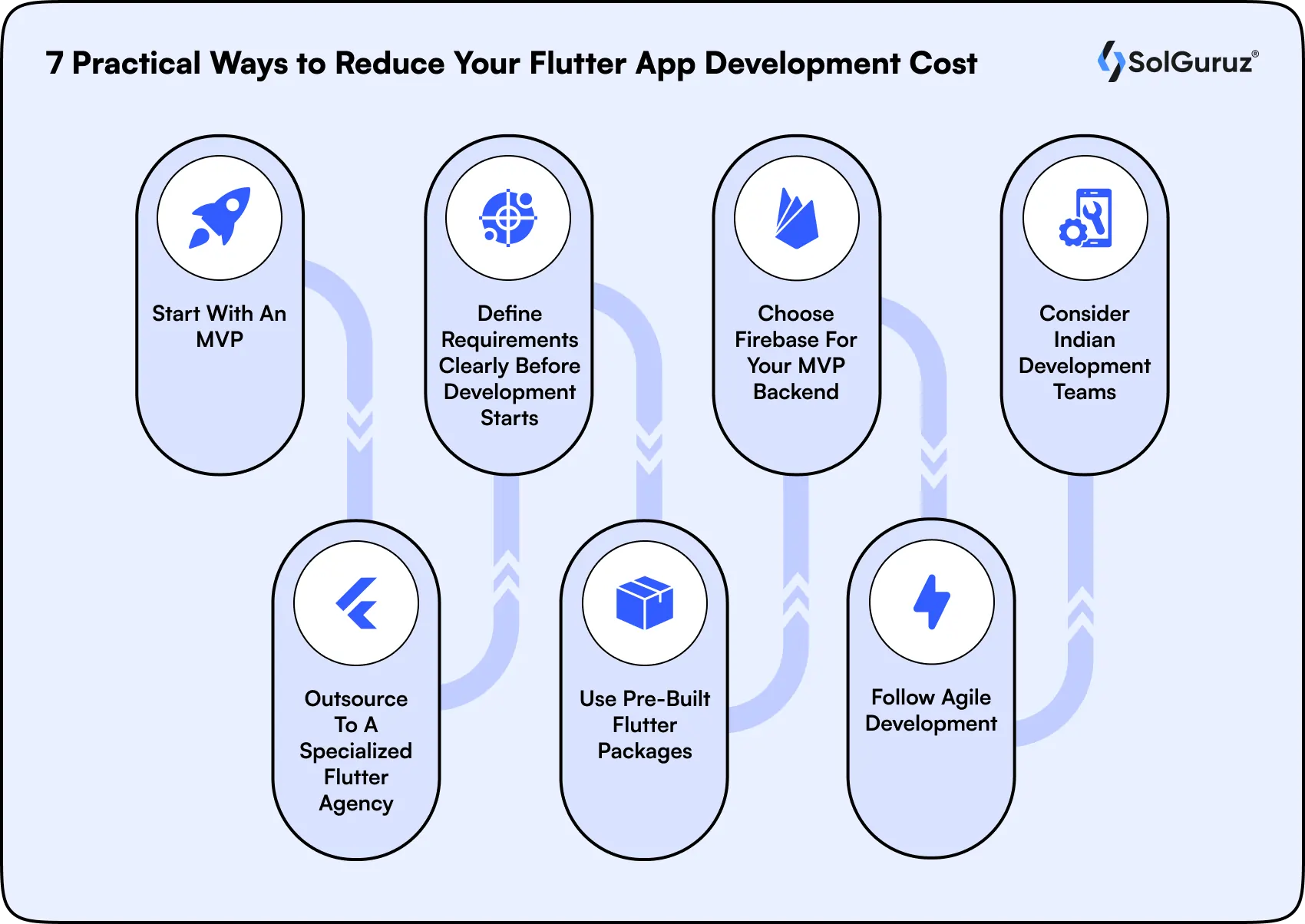
Now that you understand what drives the cost, let’s explore some practical ways to keep your Flutter app development budget under control without compromising on quality.
1. Start with an MVP.
Build only the core features that solve your primary user problem. Test with real users, collect feedback, then expand. This keeps your initial investment between $10,000 and $30,000 instead of $100,000+.
2. Outsource to a specialized Flutter agency.
You skip the overhead of hiring in-house and get a team that has already solved problems similar to yours.
3. Define requirements clearly before development starts.
Scope creep is the number-one budget killer. A well-documented requirements document saves thousands in avoided rework.
4. Use pre-built Flutter packages.
The Flutter ecosystem has thousands of production-ready plugins for common features. No need to build everything from scratch.
5. Choose Firebase for your MVP backend.
Firebase integrates natively with Flutter, reduces backend development time, and scales with your user base.
6. Follow agile development.
Break your project into 2-week sprints. This lets you adjust priorities based on real progress instead of guessing upfront.
7. Consider Indian development teams.
With rates 50-70% lower than US teams and a deep talent pool, India is the most cost-effective option for quality Flutter development.
How SolGuruz Helps You With Flutter App Development
We are a Google-recognized Flutter agency with a team of experienced Flutter developers who have delivered projects across fintech, healthcare, logistics, e-commerce, and SaaS.
Here is what sets us apart:
- Listed on Flutter’s official consultants directory by Google
- Full-cycle development: from product strategy and design to development, testing, and post-launch support
- Flexible hiring models: dedicated team, fixed-price, or time-and-material
- 1-week risk-free trial so you can evaluate our team before committing
- Strict NDA protection for your ideas and intellectual property
Whether you are launching your first MVP or rebuilding an existing app in Flutter, we can help you plan your budget and deliver a product that performs.
Conclusion
The cost of building a Flutter app in 2026 depends on what you are building, its complexity, and who is building it. Simple MVPs start around $10,000. Mid-range business apps fall between $30,000 and $80,000. Enterprise-level platforms can cost significantly more than $150,000.
The biggest cost levers are app complexity, feature count, team model, and developer location. Getting these decisions right saves you more money than negotiating hourly rates.
Start with a clear scope. Build an MVP first. Partner with a team that knows Flutter inside and out. That combination gives you the best shot at building a great product without blowing your budget.
FAQs
1. Is Flutter free to use for commercial projects?
Yes. Flutter is completely free and open-source under the BSD license. There are no licensing fees. Your costs come from development time, backend services, third-party tools, and app store fees, not from the framework itself.
2. How much does a simple Flutter app cost?
A simple Flutter app with basic features like user login, a few screens, and minimal integrations typically costs between $10,000 and $30,000. The exact price depends on design complexity, backend needs, and your development team's location.
3. What is the Flutter app development cost in India?
In India, Flutter app development costs range from $8,000 for simple MVPs to $200,000+ for enterprise platforms. Mid-complexity apps typically fall between $20,000 and $50,000. India's rates are 50-70% lower than US or Western Europe, making it a popular outsourcing destination.
4. How long does it take to build a Flutter app?
Simple apps take 6-12 weeks. Mid-complexity apps take 3-6 months. Complex enterprise apps can take 9-18 months. Flutter's single-codebase approach and hot reload feature typically make development 25-35% faster than building separate native apps.
5. Is Flutter good for enterprise-level apps?
Absolutely. Major companies like BMW (300+ Flutter engineers), Google Pay, Nubank, and Toyota use Flutter in production. The framework supports complex architectures, high-security requirements, and large codebases. It is enterprise-ready.
6. How much does Flutter app maintenance cost per year?
Annual maintenance typically costs 15-20% of your initial development investment. For a $60,000 app, that translates to $9,000-$12,000 per year covering bug fixes, OS updates, security patches, and minor improvements. Server hosting and third-party services add $1,200 to $24,000, depending on usage.
7. Flutter vs React Native: which is cheaper?
Both frameworks save money compared to native development. Flutter tends to be slightly more cost-effective because its widget-based architecture requires less bridging code, and its single rendering engine delivers more consistent results across platforms. Developer availability for both is strong in 2026.
8. What is the best way to reduce Flutter app development cost?
Start with an MVP, outsource to a specialized Flutter agency, define your requirements clearly before development begins, use pre-built Flutter packages for common features, and follow agile methodology. These practices combined can reduce your total cost by 30-50%.

Written by
Paresh Mayani
Paresh Mayani is the Co-Founder and CEO of SolGuruz, a global custom software development and product engineering company. With over 17+ years of experience in software development, architecture decisions, and technology consulting, he has worked across the full lifecycle of digital products, from early validation to large-scale production systems. He started his career as an Android developer and spent nearly a decade building real-world mobile applications before moving into product strategy, technical consulting, and delivery leadership roles. Paresh works directly with founders, scaleups, and enterprise teams where technology choices influence product viability, scalability, and long-term operational success. He partners closely with founders and cross-functional teams to take early ideas and turn them into scalable digital products. His work revolves around AI integration, agent-driven workflow automation, guiding product discovery, MVP validation, system design, and domain-specific software platforms across industries such as healthcare, fitness, and fintech. Instead of solely focusing on building features, Paresh helps organizations adopt technology in a way that fits business workflows, teams, and growth stages. Beyond delivery, Paresh is also an active tech community contributor and speaker, contributing to global developer ecosystems through Stack Overflow, technical talks, mentorship, and developer community (Google Developers Group Ahmedabad and FlutterFlow Developers Group Ahmedabad) initiatives. He holds more than 120,000 reputation points on Stack Overflow and is one of the top 10 contributors worldwide for the Android tag. His writing explores AI adoption, product engineering strategy, architecture planning, and practical lessons learned from real-world product execution.





From Insight to Action
Insights define intent. Execution defines results. Understand how we deliver with structure, collaborate through partnerships, and how our guidebooks help leaders make better product decisions.
 How we Work
Planning a Flutter App?
Get a Free Cost Estimate from a Google-Recognized Flutter Agency.

Strict NDA

Trusted by Startups & Enterprises Worldwide

Flexible Engagement Models

1 Week Risk-Free Trial