

How to Build a Fitness App in 2026: Features, Cost, and Step-by-Step Process
This guide covers everything you need to build a fitness app in 2026. From must-have features and tech stack choices to realistic cost breakdowns and monetization strategies, you will find a clear roadmap for launching a fitness product that users keep coming back to.

Summarise with AI


The global fitness app market continues to grow rapidly. According to GlobeNewswire, the market was valued at USD 12.1 billion in 2025 and is expected to reach USD 45.45 billion by 2035, growing at a 14.15% CAGR.
At the same time, competition in the space is extremely high. As of early 2026, the Health & Fitness category on the Apple App Store includes more than 130,000 apps, while the total number of apps on the platform exceeds 1.9 million. With so many options available, user expectations are also higher than ever.
Another challenge is user retention. Many apps struggle to keep users engaged, and a large percentage of new users stop using an app shortly after installing it.
So the real question for businesses is not whether fitness apps work; it’s how to build one that users actually keep using. Let’s dive in.
TL;DR
Building a successful fitness app in 2026 requires more than just coding features. You need a clear niche, a focused MVP, and features that keep users engaged, such as progress tracking, personalization, and wearable integration. Development costs typically range from $25K for a basic MVP to $300K+ for advanced platforms with AI, video, and gamification. The most successful apps follow a structured process: research the market, design a strong user experience, launch quickly, and improve continuously based on user feedback.
Table of Contents
Why Fitness App Development Is Worth Your Investment in 2026
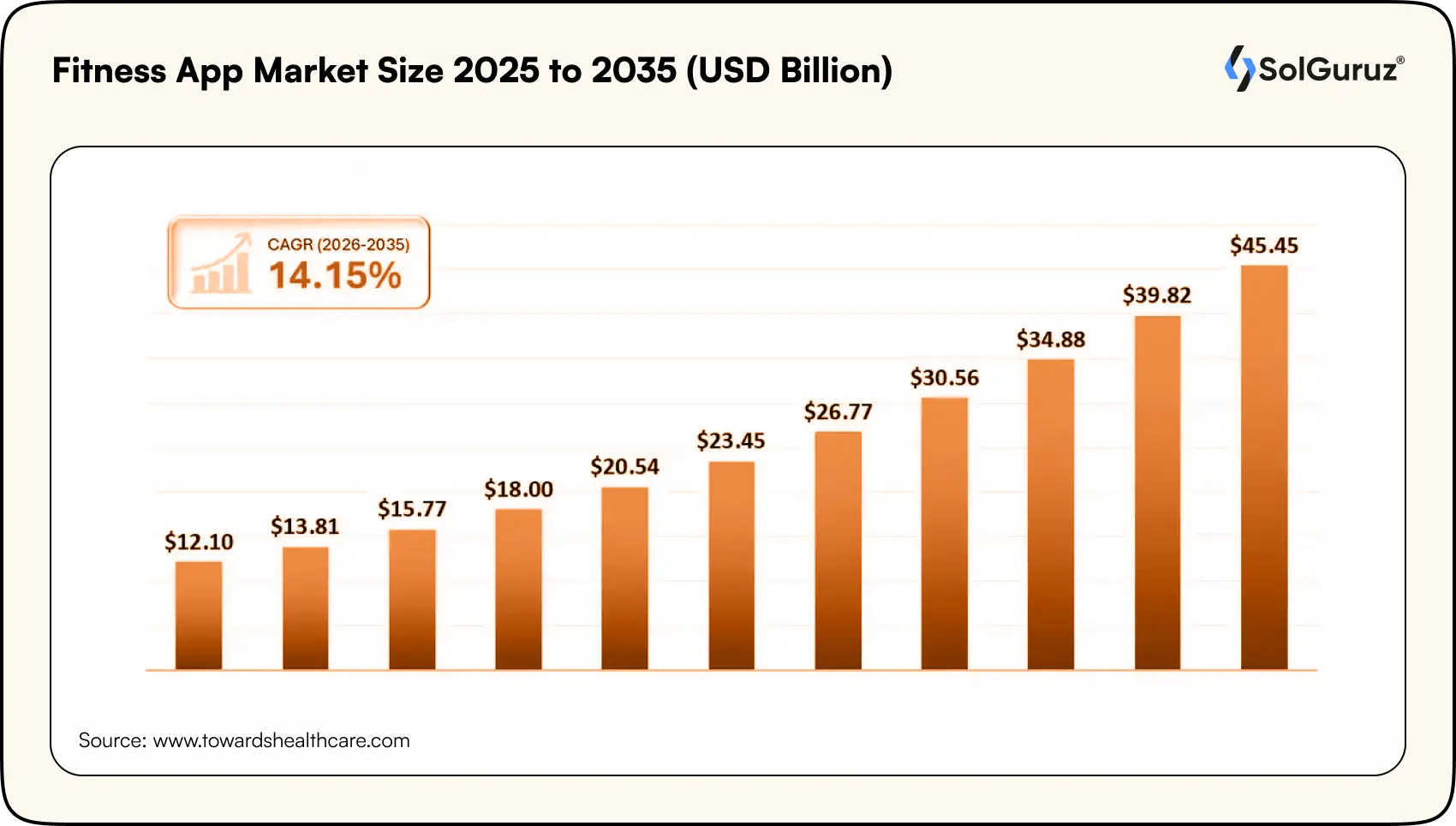
The numbers tell a compelling story. The global fitness app market hit around $12.1 billion in 2025 and reached $13.81 billion in 2026, projecting to climb toward $45 billion by 2035 at a 14%+ CAGR.
For businesses investing in mobile app development, fitness apps represent one of the fastest-growing digital product categories. Partnering with an experienced fitness app development company can help businesses turn this growing demand into scalable digital products that attract and retain users.
Fitness apps are revenue machines, subscriptions drive 70-85% of top earners’ income, outpacing ads, amid strong double-digit growth fueled by wearables and AI personalization. With billions in play and user demand surging, now’s the prime time to build one that sticks in this high-stakes arena.
Here is what is driving this growth:
- Smartphone penetration keeps rising. More people now own a smartphone than a gym membership. Fitness apps go where people already are, right in their pockets.
- Wearables are becoming mainstream. Wearables like smartwatches, bands, and rings are now mainstream, syncing real-time health data with fitness apps. The global wearable tech market hits $96-231B in 2026, up from $87B in 2025, with fitness trackers driving 30-40% growth.
- Users want personalized experiences. Generic workout plans are no longer sufficient. People want apps that adapt to their goals, fitness level, and recovery patterns.
- Remote fitness is here to stay. The post-pandemic shift toward home workouts, virtual training, and on-demand classes is now a permanent behavior.
The market is growing fast, but it also rewards apps that solve specific problems well. That brings us to the first decision you need to make: what type of fitness app to build.
Types of Fitness Apps You Can Build
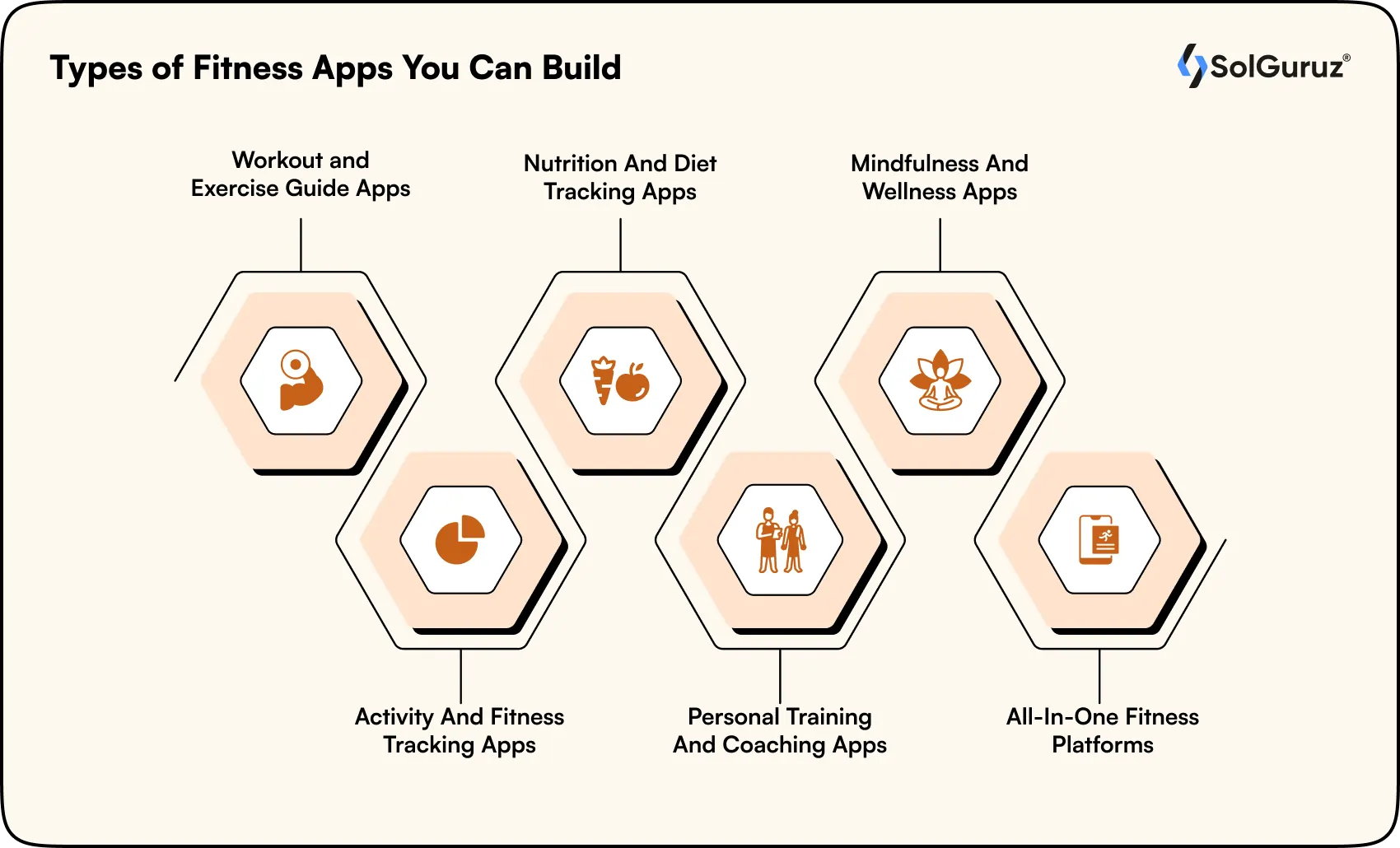
Not all fitness apps do the same thing. And picking the right type upfront saves you from building features nobody asked for. Here are the main categories that are performing well right now.
1. Workout and Exercise Guide Apps
These apps give users structured training programs with video demos, progress tracking, and personalized routines. Think Nike Training Club or JEFIT. They work well because they replace the need for a personal trainer at a fraction of the cost.
If you are building in this space, focus on clear exercise instructions, rest timers, and visible progress tracking. Users stick around longer when they can see their gains week over week.
2. Activity and Fitness Tracking Apps
Apps like Strava and Fitbit fall here. They monitor daily activities, steps, heart rate, calories burned, and sleep patterns. They typically sync with wearable devices to collect data passively.
The key to success in this category is making tracking feel effortless. The less manual input users need, the longer they will use the app.
3. Nutrition and Diet Tracking Apps
Apps like MyFitnessPal help users log meals, count calories, and plan healthier diets. The exercise and weight loss segment holds about 53% of the total fitness app market share, so there is a clear demand here.
These apps require large, verified food databases and barcode scanning. The user experience around meal logging is what separates the winners from apps that get abandoned after three days.
4. Personal Training and Coaching Apps
These connect users with certified trainers through video calls, chat, and asynchronous feedback. They support one-on-one and group coaching models.
Building a coaching app requires solid video infrastructure, scheduling features, and secure handling of sensitive health data. If you are targeting this space, plan for multi-tenant architecture so individual trainers can customize their branding.
5. Mindfulness and Wellness Apps
This is the fastest-growing segment. Apps like Headspace and Calm offer guided meditation, breathing exercises, and sleep support. Corporate wellness programs are now licensing these apps in bulk.
The challenge here is delivering a calming, intuitive experience without overwhelming users with too many options upfront.
6. All-in-One Fitness Platforms
These combine workouts, nutrition tracking, activity monitoring, community features, and coaching into a single product. Fitbit and 8fit are good examples.
If you go this route, start with two or three core features and expand based on user feedback. Trying to launch with everything at once almost always leads to a bloated app that does nothing well.
Must-Have Features for a Fitness App in 2026
The features you include will directly affect user retention, development cost, and your ability to monetize. Here is what users expect from a fitness app in 2026, broken into core and advanced features.
Core Features (Your MVP Needs These)
Let’s see some of the core features
1. User Onboarding and Profiles.
Collect fitness goals, experience level, and preferences during signup. Use engaging quizzes instead of long forms. This data powers your personalization engine.
2. Workout Library and Routines.
Include video tutorials, step-by-step instructions, and categorized exercise libraries. Let users build custom routines or follow pre-built plans.
3. Progress Tracking.
Let users log workouts, view history, and track metrics like weight lifted, reps completed, distance covered, and calories burned. Make progress visible through charts and milestones.
4. Push Notifications and Reminders.
Remind users about upcoming workouts, water intake, and streak progress. Timely nudges help users build habits and come back to the app daily.
5. Nutrition and Meal Tracking.
Let users log meals, scan barcodes, and track macronutrients. Even a basic calorie counter adds significant value for users chasing weight-related goals.
6. Advanced Features (Post-MVP Growth)
Once your MVP gains traction, adding advanced features can significantly improve user engagement, retention, and overall product value. Below are some of the advanced features mentioned, as follows:
7. Wearable Device Integration.
Sync with Apple Watch, Fitbit, Garmin, and other devices through Apple HealthKit and Google Health Connect. Real-time biometric data like heart rate and sleep quality make your app stickier.
8. AI-Powered Personalization.
Use machine learning to adapt workout plans based on user history, recovery patterns, and performance data. Apps with personalized recommendations see up to 60% higher engagement compared to static plans.
9. Social and Community Features.
Leaderboards, group challenges, social sharing, and in-app communities keep users accountable. Strava built a $1.5 billion business largely on social features.
10. Gamification.
Points, badges, streaks, and achievement levels tap into users’ desire for progress and recognition. This is one of the highest-impact features for retention.
11. Live and On-Demand Video Classes.
Offer instructor-led sessions, pre-recorded workouts, and live-streamed classes. Video content gives users a reason to open the app even on days they do not feel motivated.
12. Computer Vision for Form Correction.
This is an emerging feature in 2026. The phone camera analyzes exercise form in real time and provides feedback. It requires higher technical investment but offers strong differentiation.
Insight: Many successful fitness apps do not launch with all these advanced features at once. Most start with a focused MVP and gradually introduce capabilities like AI personalization, wearables, and gamification as the user base grows.
How to Build a Fitness App: The Step-by-Step Development Process
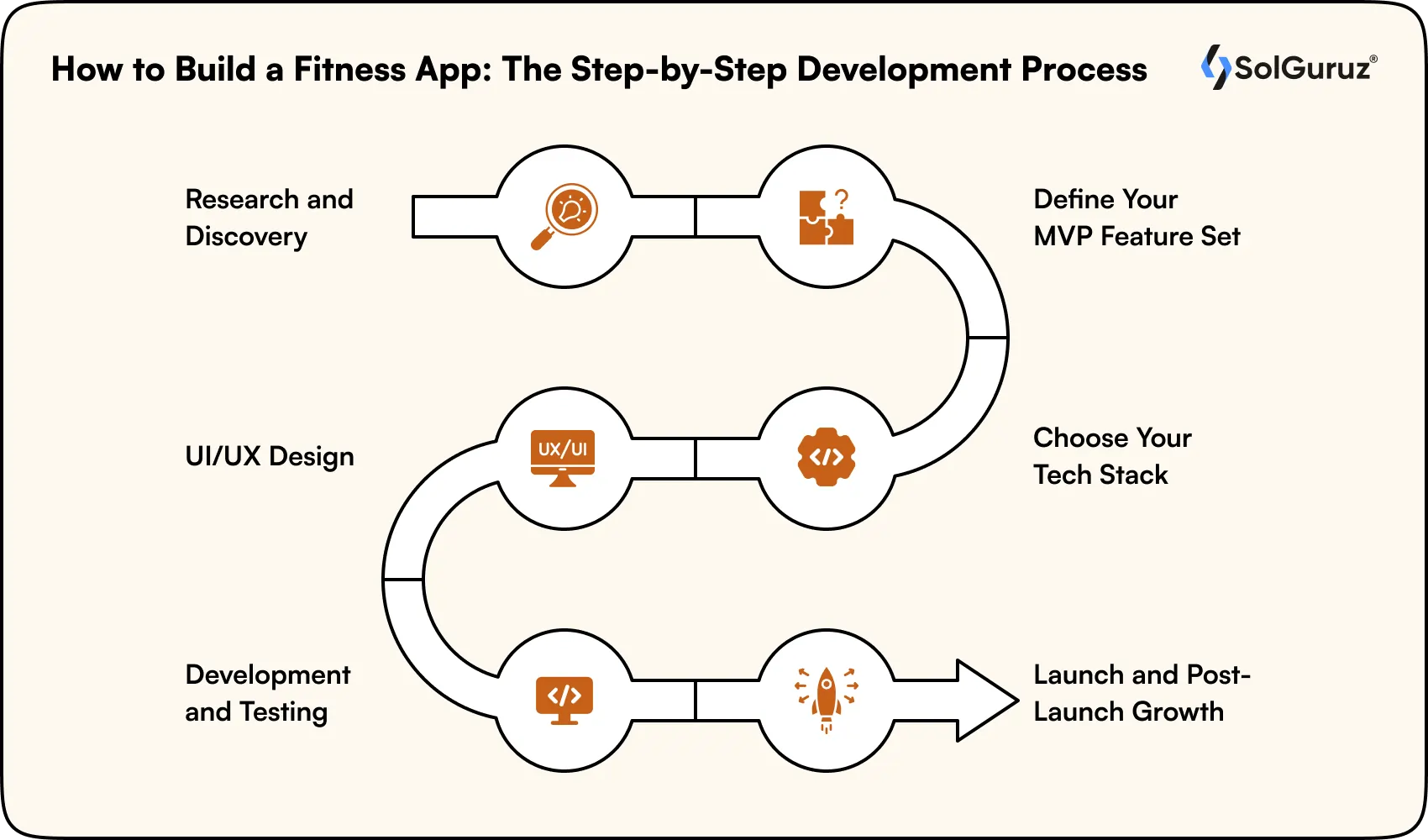
Building a fitness app is not just about writing code. The best apps come from a structured process that starts well before the first line of code is written. Here is how it works.
Step 1: Research and Discovery
Start by understanding who you are building for. A fitness app for busy professionals looks very different from one designed for competitive athletes or seniors.
Study your competitors. Download the top 10 apps in your category and use them for at least a week. Read their reviews on the App Store and Play Store. Pay close attention to what users love and what frustrates them. Those complaints are your opportunity.
Research the regulatory landscape too. If your app collects health data, you may need to comply with HIPAA (in the US) or GDPR (in Europe). Most fitness apps fall under low-risk device classifications, but it is worth checking early.
Step 2: Define Your MVP Feature Set
Resist the urge to build everything at once. Your MVP should include only the features needed to deliver your core value proposition. Everything else can come later based on user feedback.
For a workout app, that might mean: user onboarding, a workout library with 50-100 exercises, basic progress tracking, and push notifications. For a nutrition app, it could be: meal logging, calorie tracking, and a food database.
A focused MVP gets you to market faster, costs less, and gives you real data to make smarter decisions about what to build next.
Step 3: Choose Your Tech Stack
Your tech stack affects performance, scalability, development speed, and cost. Here is a common setup for fitness apps in 2026:
| Layer | Technology Options | Why It Works |
| Frontend (Mobile) | Flutter, React Native, or Native (Swift/Kotlin) | Flutter is the go-to for cross-platform in 2026. Saves 25-35% vs building two native apps. |
| Backend | Node.js, Python (Django/Flask), Ruby on Rails | Node.js handles real-time features well. Python is better for AI/ML modules. |
| Database | PostgreSQL, MongoDB, Firebase | PostgreSQL for structured data. MongoDB for flexible user-generated content. |
| Cloud | AWS, Google Cloud, Azure | AWS for scalability. Google Cloud for AI/ML integration. |
| Wearable APIs | Apple HealthKit, Google Health Connect, Fitbit SDK | Required for wearable data sync and real-time health tracking. |
| Video | Agora, Twilio, WebRTC | For live classes and trainer video calls. |
At SolGuruz, we typically recommend Flutter for fitness apps because it lets you ship on both iOS and Android from a single codebase while keeping performance close to native.
Step 4: UI/UX Design
Design is not about making the app look pretty. It is about making the app easy to use mid-workout when someone is sweating and short on patience. That is why thoughtful UI UX design plays a critical role in the success of any fitness app.
Your app should be usable with one hand. Buttons need to be large enough to tap accurately. Text should be readable at a glance. Navigation should feel obvious without a tutorial.
Start with wireframes to map user flows. Then build clickable prototypes and test them with real users before moving to development. This step alone can save you weeks of rework.
Step 5: Development and Testing
Work in sprints. Ship working builds every 1-2 weeks. This lets you catch issues early and adjust based on feedback rather than discovering problems after months of heads-down coding.
Test across multiple devices, screen sizes, and OS versions. Pay special attention to wearable syncing, GPS accuracy (for running apps), and battery usage. Fitness apps that drain battery fast get uninstalled fast.
Step 6: Launch and Post-Launch Growth
Submit your app to the App Store and Play Store. Optimize your app store listing with relevant keywords, compelling screenshots, and a clear value proposition in your description.
Plan your marketing before launch day. Social media, content marketing, influencer partnerships, and app store optimization (ASO) should all be part of your playbook.
After launch, track key metrics: daily active users, retention rate (day 1, day 7, day 30), session length, and churn rate. Use this data to prioritize your next round of features and improvements.
How Much Does Fitness App Development Cost in 2026?
This is the question everyone asks first. And the honest answer is: it depends. But here is a realistic breakdown based on what we see across the industry.
| App Complexity | Estimated Cost Range | What You Get |
| Basic MVP | $25,000 – $50,000 | Core features: onboarding, workout library, progress tracking, notifications. Single platform. |
| Mid-Range App | $50,000 – $150,000 | Core + wearable integration, nutrition tracking, social features, both iOS and Android. |
| Advanced Platform | $150,000 – $300,000+ | Full-featured with AI personalization, live video, gamification, admin dashboard, and analytics. |
What Drives the Cost Up?
The five biggest cost factors are: feature complexity (AI and video are expensive), the number of platforms you support, design quality and custom animations, wearable integrations (each SDK adds development time), and compliance requirements (HIPAA adds both development and ongoing costs).
Cross-platform development with Flutter typically saves 25-35% compared to building separate native apps for iOS and Android. That is one of the quickest ways to manage your budget without cutting features.
Do Not Forget Maintenance
Plan for ongoing maintenance at about 15-20% of your initial development cost per year. This covers bug fixes, OS updates, security patches, new feature releases, and server costs. Skipping maintenance is the fastest way to lose users you worked hard to acquire.
Remember: The real cost of a fitness app depends on your features, integrations, and product vision. Starting with a focused MVP helps validate the idea before investing in a full-scale platform.
Monetization Strategies That Work for Fitness Apps
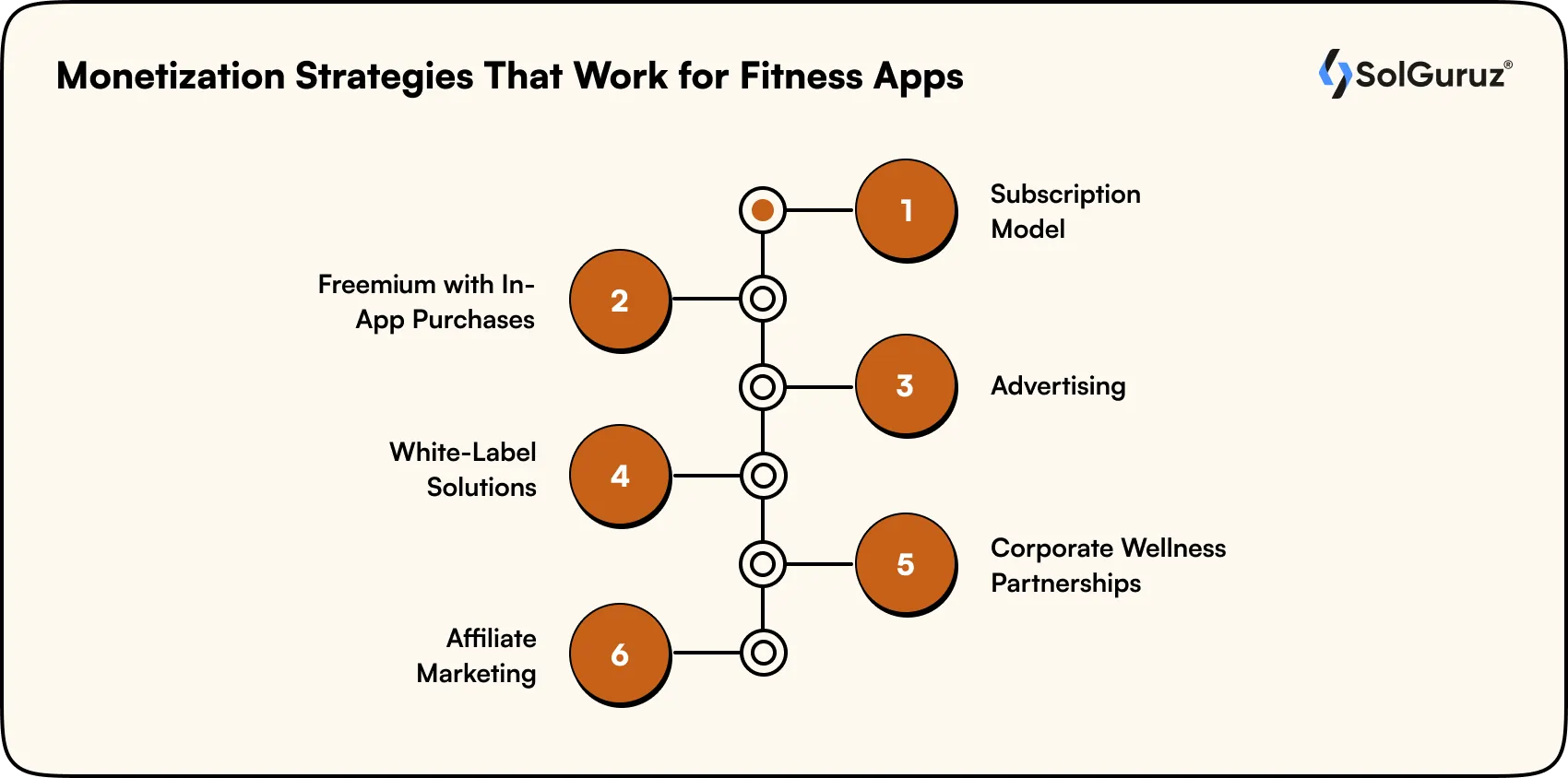
Your fitness app needs to make money. Here are the models that are working in 2026, listed in order of how commonly they are used.
1. Subscription Model.
This is the dominant model. About 80% of fitness app revenue comes from subscriptions. Offer a free tier with limited features and charge monthly or annually for premium access. Most successful apps cost between $9.99 and $19.99 per month.
2. Freemium with In-App Purchases.
Give users the basics for free and sell premium workout packs, meal plans, or personalized coaching as one-time purchases. This works well for apps with a large free user base.
3. Advertising.
Display ads between workout sets or on dashboard screens. Keep it tasteful. Heavy ad placement drives uninstalls. Consider offering an ad-free tier as part of your premium plan.
4. White-Label Solutions.
License your platform to gyms, personal trainers, or wellness centers who want a branded app without building one from scratch. This is a strong B2B revenue stream.
5. Corporate Wellness Partnerships.
Partner with HR departments for bulk licensing. Corporate wellness is a massive growth area in 2026 and creates predictable, high-volume revenue.
6. Affiliate Marketing.
Promote fitness equipment, supplements, or meal delivery services within your app and earn commissions on each sale. Only promote products that genuinely align with your users’ goals.
Common Challenges in Fitness App Development (and How to Solve Them)
Building a fitness app is exciting, but it also comes with several technical and product challenges. Understanding these early helps teams design better solutions and avoid costly mistakes later.
1. Low Retention Rates.
The average fitness app loses 96% of its users within 30 days. Combat this with personalized onboarding, gamification, streak tracking, and timely push notifications that feel helpful rather than spammy.
2. Data Privacy and Security.
You are handling sensitive health data. Build with encryption, secure authentication, and compliance from day one. Retrofitting security is expensive and risky.
3. Wearable Integration Complexity.
Each wearable brand has its own SDK and data format. Plan for this in your architecture. Start with Apple Watch and Fitbit (the two largest ecosystems) and expand from there.
4. Standing Out in a Crowded Market.
Do not try to be everything. Pick one thing your app does better than anyone else and build your brand around it. Strava owns social running. Headspace owns guided meditation. What will you own?
5. Scalability.
Your app needs to handle growth without breaking. Use cloud infrastructure (AWS, Google Cloud) and design a modular architecture from the start. What works for 1,000 users should also work for 100,000.
Why Work With SolGuruz for Fitness App Development?
As a fitness app development company, SolGuruz has built fitness apps that people actually use. From workout trackers to AI-powered coaching platforms, our team understands what works in this space and what does not.
Here is what makes working with us different:
- We think product, not just code. Every feature decision is tied to a business goal, whether that is retention, monetization, or user growth.
- We ship fast. Working builds every 1-2 weeks. You see progress constantly, not just at the end.
- We handle the full lifecycle. From product strategy and design to development, QA, launch, and ongoing support. You get one team from start to finish.
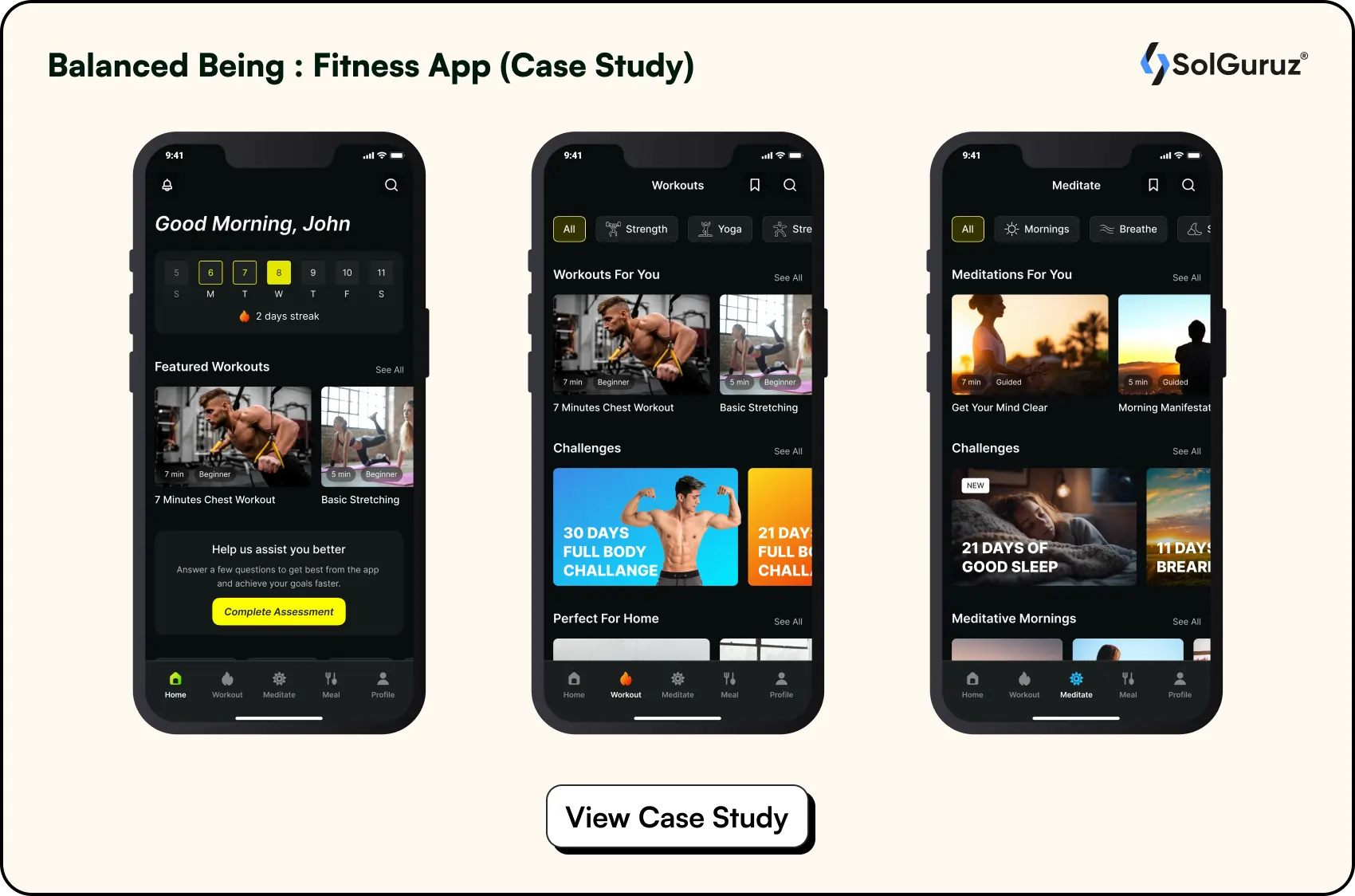
- We have done this before. Check out our fitness app case study to see how we built a full-featured AI-powered fitness platform with meditation, workouts, challenges, and meal planning.
Conclusion
The fitness app market is not slowing down. With $13.81 billion in 2026 and a trajectory toward $45 billion by 2035, there is plenty of room for apps that solve real problems for real users.
But launching a successful fitness app requires more than a good idea. You need a clear understanding of your target audience, a focused MVP, the right tech stack, and a partner who can help you execute without wasted time or money.
Whether you are building a workout tracker, a nutrition app, or a full-featured coaching platform, the steps in this guide give you a solid foundation to work from.
Ready to take the next step? Talk to our team about your fitness app idea. We will help you scope it out and build something your users will not want to delete.
FAQs
1. How much does it cost to develop a fitness app in 2026?
A basic MVP typically costs $25,000 to $50,000. Mid-range apps with wearable integration and social features run $50,000 to $150,000. Advanced platforms with AI, live video, and gamification can exceed $300,000. Cross-platform development with Flutter can save 25-35% compared to building separate native apps.
2. How long does it take to build a fitness app?
A focused MVP takes 3-4 months. A mid-range app with wearable integration and multiple features takes 5-8 months. Complex platforms with AI, live streaming, and admin dashboards can take 9-12 months or longer.
3. What tech stack should I use for a fitness app?
Flutter is the most popular cross-platform framework for fitness apps in 2026. For backend, Node.js works well for real-time features,s and Python (Django/Flask) is preferred for AI/ML modules. PostgreSQL and MongoDB are the most common database choices. For wearable integration, you will need Apple HealthKit and Google Health Connect APIs.
4. How do fitness apps make money?
The dominant model is subscriptions, which account for about 80% of fitness app revenue. Other models include freemium with in-app purchases, advertising, white-label licensing, corporate wellness partnerships, and affiliate marketing.
5. Do I need to comply with HIPAA for a fitness app?
If your app is designed for general wellness (tracking steps, workouts, calories) and does not diagnose, treat, or prevent diseases, it typically does not require FDA submission or HIPAA compliance. But if your app collects or shares health data with healthcare providers, HIPAA may apply. Check with a compliance expert early in your development process.
6. What features should a fitness app MVP include?
At minimum, your MVP should have user onboarding with goal setting, a workout library with video instructions, basic progress tracking, push notifications, and either iOS or Android support. Add nutrition tracking if your app targets weight management. Save wearable integration, AI personalization, and social features for post-MVP updates.
7. How do I choose the right fitness app development company?
Look for a company with proven experience in fitness or health tech (ask for case studies). Check their tech stack expertise, communication style, and project management approach. A good partner will challenge your assumptions and help you prioritize features rather than just building whatever you ask for.
8. What is the biggest reason fitness apps fail?
Low retention. Most fitness apps lose 96% of their users within 30 days. The apps that survive invest heavily in personalization, gamification, community features, and timely notifications that keep users coming back. Building a great app is only half the job. Keeping users engaged is the other half.

Written by
Paresh Mayani
Paresh Mayani is the Co-Founder and CEO of SolGuruz, a global custom software development and product engineering company. With over 17+ years of experience in software development, architecture decisions, and technology consulting, he has worked across the full lifecycle of digital products, from early validation to large-scale production systems. He started his career as an Android developer and spent nearly a decade building real-world mobile applications before moving into product strategy, technical consulting, and delivery leadership roles. Paresh works directly with founders, scaleups, and enterprise teams where technology choices influence product viability, scalability, and long-term operational success. He partners closely with founders and cross-functional teams to take early ideas and turn them into scalable digital products. His work revolves around AI integration, agent-driven workflow automation, guiding product discovery, MVP validation, system design, and domain-specific software platforms across industries such as healthcare, fitness, and fintech. Instead of solely focusing on building features, Paresh helps organizations adopt technology in a way that fits business workflows, teams, and growth stages. Beyond delivery, Paresh is also an active tech community contributor and speaker, contributing to global developer ecosystems through Stack Overflow, technical talks, mentorship, and developer community (Google Developers Group Ahmedabad and FlutterFlow Developers Group Ahmedabad) initiatives. He holds more than 120,000 reputation points on Stack Overflow and is one of the top 10 contributors worldwide for the Android tag. His writing explores AI adoption, product engineering strategy, architecture planning, and practical lessons learned from real-world product execution.





From Insight to Action
Insights define intent. Execution defines results. Understand how we deliver with structure, collaborate through partnerships, and how our guidebooks help leaders make better product decisions.
 How we Work
Want to Build a Fitness App That Users Actually Keep?
SolGuruz builds fitness apps with smart tracking, personalized workouts, and scalable architecture. From MVP to full-scale launch.

Strict NDA

Trusted by Startups & Enterprises Worldwide

Flexible Engagement Models

1 Week Risk-Free Trial